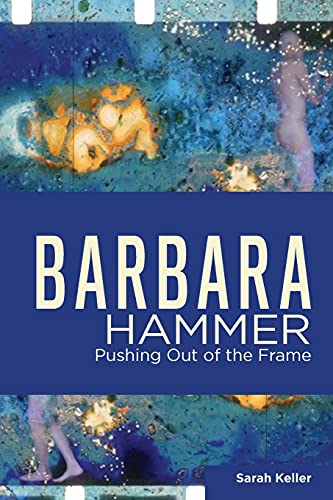
Barbara Hammer : pushing out of the frame / Sarah Keller.
Material type: TextLanguage: English Series: Queer screensPublication details: Detroit : Wayne State University Press, 2021Description: viii, 225 p. : ill. ; 23 cmISBN:
 - 9780814348581 (pbk)
- 9780814348598 (hbk)
- Barbara Hammer
| Cover image | Item type | Current library | Home library | Collection | Shelving location | Call number | Materials specified | Vol info | URL | Copy number | Status | Notes | Date due | Barcode | Item holds | Item hold queue priority | Course reserves | |
|---|---|---|---|---|---|---|---|---|---|---|---|---|---|---|---|---|---|---|
 Libri
Libri
|
BOLOGNA | Centro di Documentazione "Flavia Madaschi" Cassero LGBTQIA+ Center | L 791.430 KEL | Available | 1 v. | BO19632 |
Introduction: Experimentation in the first films ; Ambition and legacy ; The chapters -- 1970s: Barbara Hammer, queer pioneer. The early years ; I was/I am (1973) ; Lesbian bodies, queer experimental pioneer ; Radical form for radical content -- 1980s: Vocation and expansion. Travel and place: Our trip (1980), Pools (1981), and Bent time (1984) ; Intimacy and Sync touch (1981) -- The arrival of Optic nerve (1985) ; Technological experiments and No no nooky T.V. (1987) ; Still point (1989) ; Janus-facing the 1980s -- 1990s: Rewriting herstory. Not bare bones/Between things ; Nitrate kisses (1992) ; Out in South Africa (1994) ; Rewriting history: Tender fictions (1995) and The female closet (1998) -- 2000-2019: Legacy. History lessons (2000) and Resisting Paradise (2003) ; A horse is not a metaphor: or is it? ; Maya Deren's sink (2011) and Welcome to this house (2015): traces of film, people, and places ; Evidentiary bodies x 4 ; Conclusion? Further issues of legacy -- A few last words: Hammer on Hammer.
"Barbara Hammer tends to be best known for her work from the 1970s. In those years, she radically represents female subjects and subjectivity in a series of films that are both part of and ahead of their time. Films like Dyketactics (1974), Menses (1974), Superdyke (1975), and Multiple Orgasm (1976) explore lesbian sexuality, feminist identity, and social activism. Hammer recorded non-actors (including herself) in frank acts of lesbian sex; showed parts of the female experience (and anatomy) usually elided in filmic depictions of women; staged rituals portraying women in various attitudes of empowerment; and subsequently provided models for feminist action and power. Granting exposure to a decidedly feminist and lesbian sensibility starting with these early films, Hammer has frequently and rightly been seen as a pioneer of queer cinema. If her productivity had been limited to the 1970s, her importance to queer film and art histories would still be assured, though perhaps skewed a bit toward frameworks of identity for understanding her artistic commitments"
There are no comments on this title.